About This Blog:

The primary purpose of this blog is to showcase the best of my aviation photography. As such, you will find links to my main aviation gallery on Facebook containing photos from aircraft spotting, some kind of aviation event such as air shows and fly-in events, as well as aviation museums. I also critique my flights on commercial airlines and the services they provide. Occassionally, you'll find personally written, independent articles based on news and current events involving aviation. And of course, I'll put up links to official and unofficial aviation-related websites when I find them. And when time permits, I'll talk and discuss about anything involving aviation. But most importantly, this is my way to document my journey into the aviation industry!
Showing posts with label Articles. Show all posts

Monday, August 22, 2022

A Sight No More: ExpressJet Airlines & "aha!"

Today, "aha!" Airlines along with its parent company ExpressJet Airlines filed for Chapter 11 bankruptcy and ceased all operations. While Chapter 11 bankruptcy is typically used as legal protection in order to restructure, the airline has intended to liquidate its assets.

This is unfortunate, but not surprising news, considering that since resuming operations as an independent niche carrier after losing it's last CPA contract with United in 2020, ExpressJet's "Aha!" branded operations in reality, hasn't appeared viable, based on load factors and the inability to roll out the air-hotel-adventure vacation packages that was to be the foundation of it's business model (much like Allegiant scaled down); as a result, the airline has been facing lower-than-expected revenues. Passenger complaints about how disorganized the operation has been has done nothing more but tarnish the airline's reputation. The ongoing repercussions from the COVID-19 pandemic (especially from its variants) as well as the high-cost of jet fuel were likely contributing factors.

Again, unfortunate news because you feel for the employees who lost their jobs. Unfortunate because this particular operation hasn't even lasted a year. On paper, the ExpressJet's "aha!" business model looked like a good idea. Reality however, showed otherwise. And I was certainly rooting for them because they were underdogs, but I too had doubts regarding the viability of ExpressJet's "Aha!" branded operations; with very thin markets of the routes they operated and the high-cost equipment they flew, it seemed blatantly obvious that this was a weak business model.

So this is the end of a storied regional airline name. With only a handful of jets in their fleet since resuming operations and having continuously operated into Eugene, Oregon from launch to shutdown, I was fortunate to have been able to photograph all of their ERJ-145s when the opportunity permitted. With that, here's a photo montage:

Embraer EMB-145LR ERJ-145LR (N844HK) on the inaugural flight to Eugene.

N844HK receiving the water cannon salute. All ERJ-145s ExpressJet operated as part of their "Aha!" operations were former Trans States Airlines frames.

N844HK airborne on the inaugural departure out of Eugene. The first day of flights was a rather dreary day...

Embraer EMB-145LR ERJ-145LR (N846HK), the only airframe that wore the complete "aha!" livery shown on the renderings.

In many of the destinations it served, ExpressJet's "Aha!" branded operations flew 2-3 times weekly.

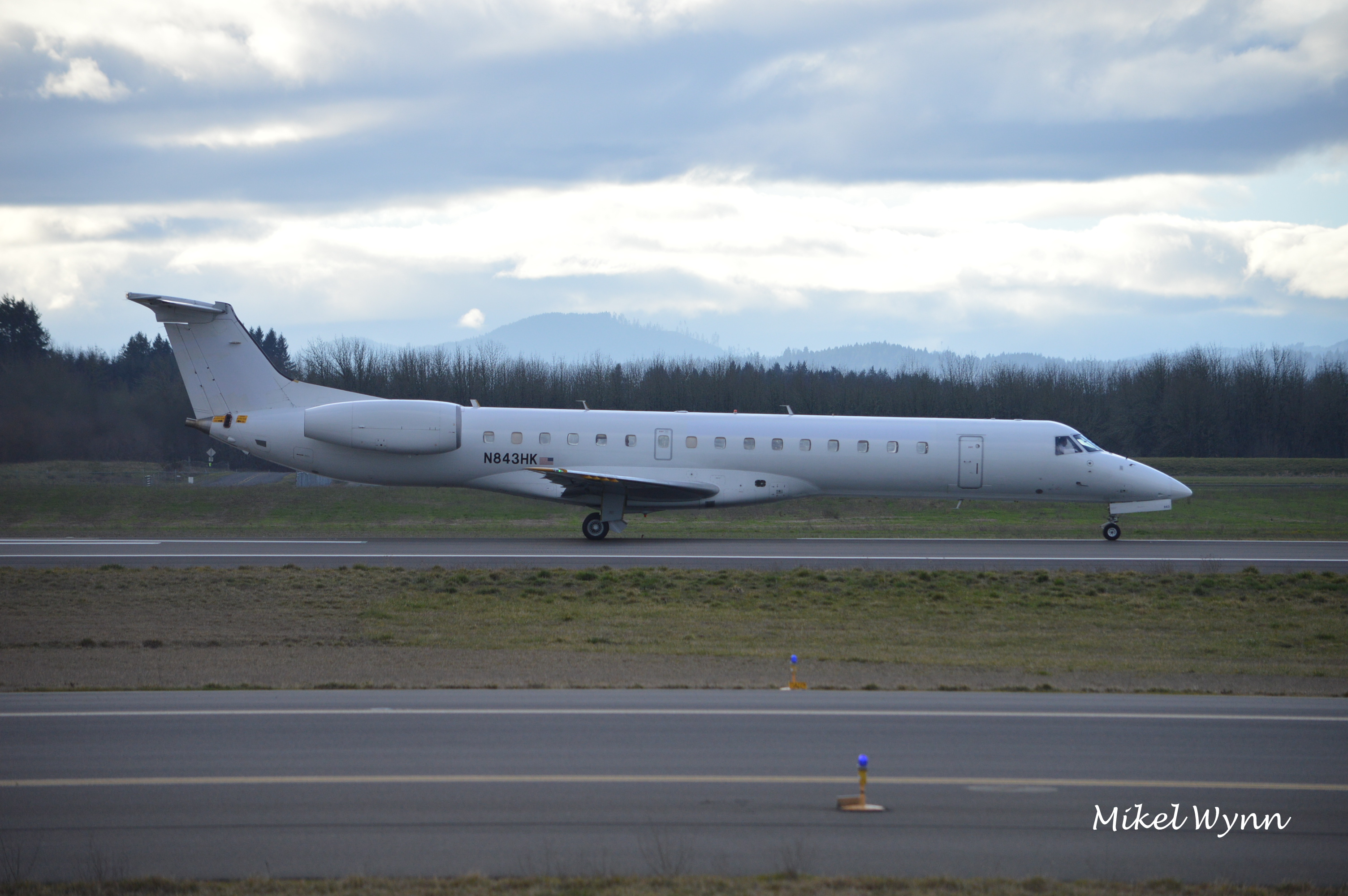
Embraer EMB-145LR ERJ-145LR (N843HK). This airframe clearly had a bit of an identity crisis as it never even received any livery.

Clearly, this airframe was rushed into service so the airline didn't have time to get it painted.

On the left side of the fuselage, it's quite evident who the previous operator of this frame was!

After United transferred all the ERJ-145XLRs ExpressJet used to operate on their behalf, they picked up these second-hand ERJ-145LRs previously operated by Trans States Airlines and these airframes were probably some of the oldest ERJ-145s in operation.

Catching N844HK in more ideal weather conditions compared to their inaugural flights in and out of Eugene.

Upon resuming operations independently for the final time, ExpressJet maintained one airframe bearing the ExpressJet logo.

Embraer EMB-145LR ERJ-145LR (N839HK). This was the other airframe to sport the "Aha!" logo, but still retained the partial livery/cheatline of United Express back when it was operated by Trans States Airlines.

The airframe spent most of the winter and spring this year operating college sports charter flights out east prior to returning to scheduled passenger service (needless to say, I caught this airframe just in time!).

In total, ExpressJet's "Aha!" operations flew to 12 destinations from their Reno hub. It's too bad they weren't able to make things work out...

With that, a storied airline name, once the largest operator of the ERJ-145 comes to a rather unspectacular and unclimactic end. One of three new airline brands that started up in 2021, "Aha!" would be the one to go belly-up. I wish the employees and flight crews of ExpressJet the best of luck in securing other employment.

Thursday, February 17, 2022

Tribute: Remembering Gail Halvorsen, the "Berlin Candy Bomber" and "Uncle Wiggly Wings"

Colonel Gail Seymour Halvorsen (October 10, 1920 - February 16, 2022)

This morning, we were saddened to learn the passing of Gail Halvorsen at the age of 101 years old yesterday in Provo, Utah on February 16, 2022. Colonel Gail Seymour Halvorsen was born on October 10, 1920 in Salt Lake City, Utah and served as a senior officer and command pilot of the United States Air Force. He learned to fly in rural Utah and earned his private pilots license in 1941 before joining the Civil Air Patrol. Colonel Halvorsen joined the United States Army Air Force in 1942 and was eventually assigned to Germany in 1948 in order to fly for the Berlin Airlift as part of Operation Vittles at the onset of the Cold War flying Douglas C-47 Skytrains and C-54 Skymasters. Best known as the "Berlin Candy Bomber" and "Uncle Wiggly Wings" (for rocking and wiggling his wings whenever his plane approached Berlin for the children to look out for), he is famous for kickstarting Operation "Little Vittles," a humanitarian operation that was a part of Operation Vittles, which dropped candy via miniature parachutes for German children during the Berlin Airlift in order to raise morale.

Colonel Halvorsen speaking at the 2018 groundbreaking ceremony for the Gail S. Halvorsen Aviation Center being built at the Spanish Fork Airport in Utah. 

Colonel Halvorsen initially began "Little Vittles" with no authorization from his superiors. But within a year, word of his humanitarian gesture reached Lieutenant General William H. Turner, airlift commander of the whole operation, who ordered the expansion of the "Little Vittles" operations. Support for the candy-dropping efforts grew, first from Halvorsen and his pilot friends flying in the Berlin Airlift, then to his whole airlift squadron, and then to the United States. When news of Operation "Little Vittles" reached the United States, American children and candy makers from throughout the country began contributing. Over 23 tons of candy was dropped as part of "Little Vittles" via over 250,000 miniature parachutes from September 1948 until May 1949. Halvorsen himself became a national hero and received the Congressional Gold Medal among other numerous awards for his part in Operation "Little Vittles." Many also consider him a hero of the Cold War, an icon of the West standing its ground against the expansion of a then-Soviet-led Communism.

Halvorsen flew C-47 Skytrains much like this one.

Douglas C-54G Skymaster on display the Hill Aerospace Museum in Ogden, Utah. This particular airframe actually flew in the Berlin Airlift and is now painted to look like the plane Halvorsen flew during the airlift in commemoration of his contributions to Operation "Little Vittles." Throughout the Wasatch and Utah Valleys, Halvorsen has been a well-known fixture in Utah communities, including The Church of Jesus Christ of Latter-day Saints, which he was also a prominent member of.

After the Berlin Airlift, Colonel Halvorsen continued his military and humanitarian career, spanning 25 years where he advocated for and performed candy drops in Bosnia-Herzegovina, Albania, Japan, Guam, and Iraq. His professional and military career included various notable positions, including his contributions which led to the development of reusable manned spacecraft at the Directorate of Space and Technology and served as commander of Berlin Tempelhof Airport. Halvorsen retired from Air Force service in 1974 after logging over 8,000 flying hours. From 1976 until 1986, he served as the Assistant Dean of Student Life at Brigham Young University in Provo, Utah. The legacy of Operation "Little Vittles" had a profound impact in the United States and throughout the world. Even after retiring from the military, Colonel Halvorsen continued to serve the local, national, and international community in a variety of ways.

Halvorsen's candy drop had also been a fixture and many local aviation events, albeit in a more educational and fun setting, including the 2018 groundbreaking ceremony of the Gail S. Halvorsen Aviation Center pictured here.

I also had the privilege of meeting and shaking hands with Colonel Gail Halvorsen, back in 2016. He was truly an inspiration and a fine gentleman.

Colonel Halvorsen and I at a 2016 aviation event that took place at the Spanish Fork Airport in Utah. This was without a doubt a very memorable moment in my life and I treasure it even more so now...

To you, Colonel Gail S. Halvorsen, blue skies and tailwinds sir! You will be greatly missed! And thank you for your inspirational service! His legacy lives on and it would be very appropriate to eat a chocolate bar in his memory.

Saturday, March 17, 2018

Tribute: In Memory of Paul Ross Wynn, My Grandfather

On Wednesday, March 7, 2018 my dear Grandfather, Paul Ross Wynn peacefully passed away at the age of 91. And today, my family and I laid him to rest in his hometown of Ashton, Idaho, a community where I to this day, hold special ties to. My Grandfather was one of the reasons why I became interested in aviation and eventually, inspired me to become a pilot and pursue a career in aviation.

The V-tailed Beechcraft 35 Bonanza, one my grandfather's favorite aircraft. He once two of them during his lifetime.

My Grandfather earned his pilots license at the age of 16; his interest in aviation was sparked one day when he and his father were driving on a long-distance trip when suddenly, their truck was buzzed by a Douglas DC-3 at low altitude! Initially rattled, followed by some good laughs, my Grandfather caught the bug and got the courage to ask his father, who would allow it on the condition that he would not fly on the Sabbath, a promise he kept his entire life.

To think that a Douglas DC-3 buzzing my grandfather while with his father would inspire him to become a pilot and let aviation become a large part of his life... Times were truly different back then!

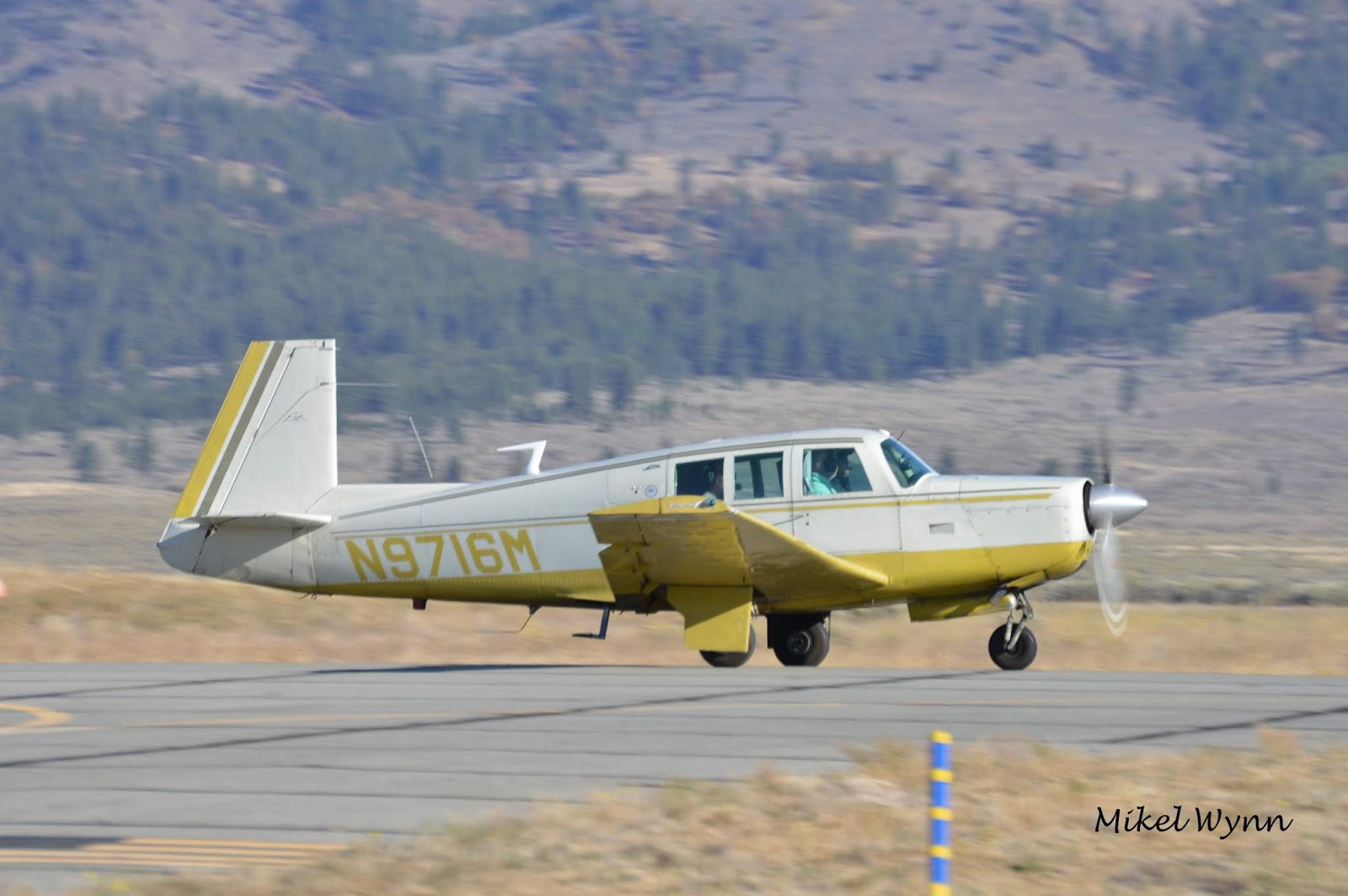
My Grandfather was a General Aviation pilot all his life, having logged thousands of hours flying over every U.S. state, Canada, Mexico, and parts of South America. Throughout his life, my Grandfather owned nine different airplanes including two Beechcraft Bonanzas, a Cessna 172, a Piper Cub, an ERCO Ercoupe, and a Mooney M20 among others.

Mooney M20

Piper Cub

ERCO Ercoupe

Cessna 172

My grandfather served in the United States Navy towards the end of World War II. Though he wanted to be a pilot, the Navy stopped accepting applications for such a position since the United States was on the verge of winning the war. Still wanting to fly, he then applied to be a radio operator on a bomber aircraft, the Grumman TBF Avenger. One of his favorite stories from flying on board the Avenger was prank pulled on greenhorn crew members as a sort of 'initiation.' On board is a funnel with a hose attached, which crew members were told it was the primary means to talk to the pilot flying the plane. Except it wasn't meant for talking; it was used to go the bathroom in! Greenhorn crew members (including my grandfather!) were punked with the infamous 'pee tube!'

My grandfather was a crew member on Grumman Avenger torpedo bombers much like this one.

My grandfather's Navy portrait.

My grandfather's World War II Victory Medal and American Campaign Medal.

My entire family and I will miss him dearly. But all of our lives have been touched by Paul Ross Wynn, our grand patriarch for the better and we are grateful for him. I am personally grateful that I had 27 years to get to know him and to share the same passion we have in aviation and airplanes. As a pilot myself, I owe it to my grandfather to carry on a portion of his grand legacy; every flight I take as pilot-in-command from now on will have God on one wing, and my grandfather's spirit on the other.

Love you, Gramps! I will miss you! And thank you for inspiring me to become the man I am today!

Grandpa Ross, as I remember him!

Friday, December 22, 2017

Amazing Aircraft: The Beechcraft Bonanza

A General Aviation aircraft near and dear to my grandfather's heart (he once owned two of them!) would be the Beechcraft Bonanza, which first flew 72 years ago today on December 22, 1945. A six-seat single-engine General Aviation civil utility aircraft, the Bonanza was formally introduced in 1947 as one of two new post-World War II designs (the other being the Cessna 195) for the premium end of the civil aviation market. The Bonanza family is comprised of three basic models:


  • The Model 35 Bonanza was produced from 1947 to 1982 and is distinctive for it's iconic V-tail.
  • The Model 33 was produced from 1959 to 1995 and was initially known as the Debonair before being renamed Bonanza; the Model 33 Bonanza is essentially a Model 35 airframe with a conventional straight-tail design. 
  • The Model 36 Bonanza is a stretched Model 33 and the current model presently still in production since 1968. 


The most distinctive feature for the early Bonanza family members (the Model 35) would be that iconic V-tail (equipped with a combination elevator-rudder called a "ruddervator"), which made it both efficient and the most distinctive private aircraft in the sky. The Bonanza holds the record for longest continuously produced aircraft of all time; production of the Bonanza continues today through the Model 36. Over 17,000 airframes (combined from all Bonanza family models) have been produced, an impressive feat for a high-end General Aviation aircraft.

Let's wish this enduring General Aviation icon a Happy 72nd Birthday with a montage of all Bonanza models!

Beechcraft S35 Bonanza (N8902U).

Beechcraft K35 Bonanza (N954DR).

Beechcraft K35 Bonanza (N5335E).

Beechcraft H34 Bonanza (N7997D).

Beechcraft G36 Bonanza (N691CB).

Beechcraft 35-33 Debonair (N241HA).

Beechcraft 35-C33 Debonair (N1310A).

Beechcraft A36 Bonanza (N8142N).

Beechcraft V35B Bonanza (N3650A).

Beechcraft J35 Bonanza (N8247D).

Beechcraft G35 (N4618D).

Beechcraft M35 Bonanza (N9324Y).

Beechcraft F35 Bonanza (N5038B).

Beechcraft M35 Bonanza (C-FNTI).

Beechcraft J35 Bonanza (N7231B).

Beechcraft G36 Bonanza (N136HB).

Beechcraft F33C Bonanza (N14JP), a Model 33 certified for aerobatics. This particular aircraft can be seen flying on the air show circuit by Jim Peitz of Jim Peitz Aerosports.

Beechcraft A35 Bonanza (N8483A).

Friday, December 15, 2017

A Sight No More: PenAir in the Pacific Northwest

In September 2015, Anchorage-based regional carrier PenAir came to the Pacific Northwest, establishing a hub at Portland International Airport with the intent of serving several under-served routes in the region as well as fulfill an Essential Air Service (EAS) contract with service to to Del Norte County Regional Airport in Crescent City, California. After getting the Portland-Crescent City route underway, PenAir expanded their Pacific Northwest network out of Portland starting in 2016 with flights to additional California destinations including Arcata-Eureka and Redding along with two Oregon destination for intrastate services including North Bend/Coos Bay and Klamath Falls.

However on August 7, 2017, PenAir filed for Chapter 11 bankruptcy protection and made the decision to end all flights out of Portland and their recently-established Denver hubs; routes in California and Oregon that weren't part of Essential Air Service were terminated within days. The terms of the Essential Air Service contract required that PenAir continue to operate those routes until a new airline could be awarded the contract, and in the case of the Pacific Northwest, the only route that remained until today was between Portland and Crescent City. PenAir operated their last flights between Portland and Crescent City today, ending a two-year long presence in the Pacific Northwest.

We have seen in recent months and years how the airline industry can have an ugly side. The world of Essential Air Service flying and any short regional flying like what PenAir does can be filled with uncertainty, especially for dedicated employees who get dragged through the mud in such a mess. PenAir brought a little variety into Portland with their Saab turboprops, and they will be sorely missed. If they survive, let's hope they'll find an opportunity to return to the markets they've left.

Here's a montage of all the PenAir aircraft I managed to photographed in Portland during the two years they served:

Saab 340B/Plus (N410XJ)

Saab 340B (N677PA)

Saab 340B (N365PX) "Spirit of Unalakleet"

Saab 340B/Plus (N404XJ) "Spirit of Unalaska"

Saab 340B (N685PA)

Saab 340B/Plus (N331AG)

Best wishes to all the PenAir employees who have been affected by the bankruptcy and the subsequent shutdowns of their domiciles, which have dislocated them. And best of luck to the company with the bankruptcy proceedings and the hope that the airline will continue to serve communities they're committed to for years to come.