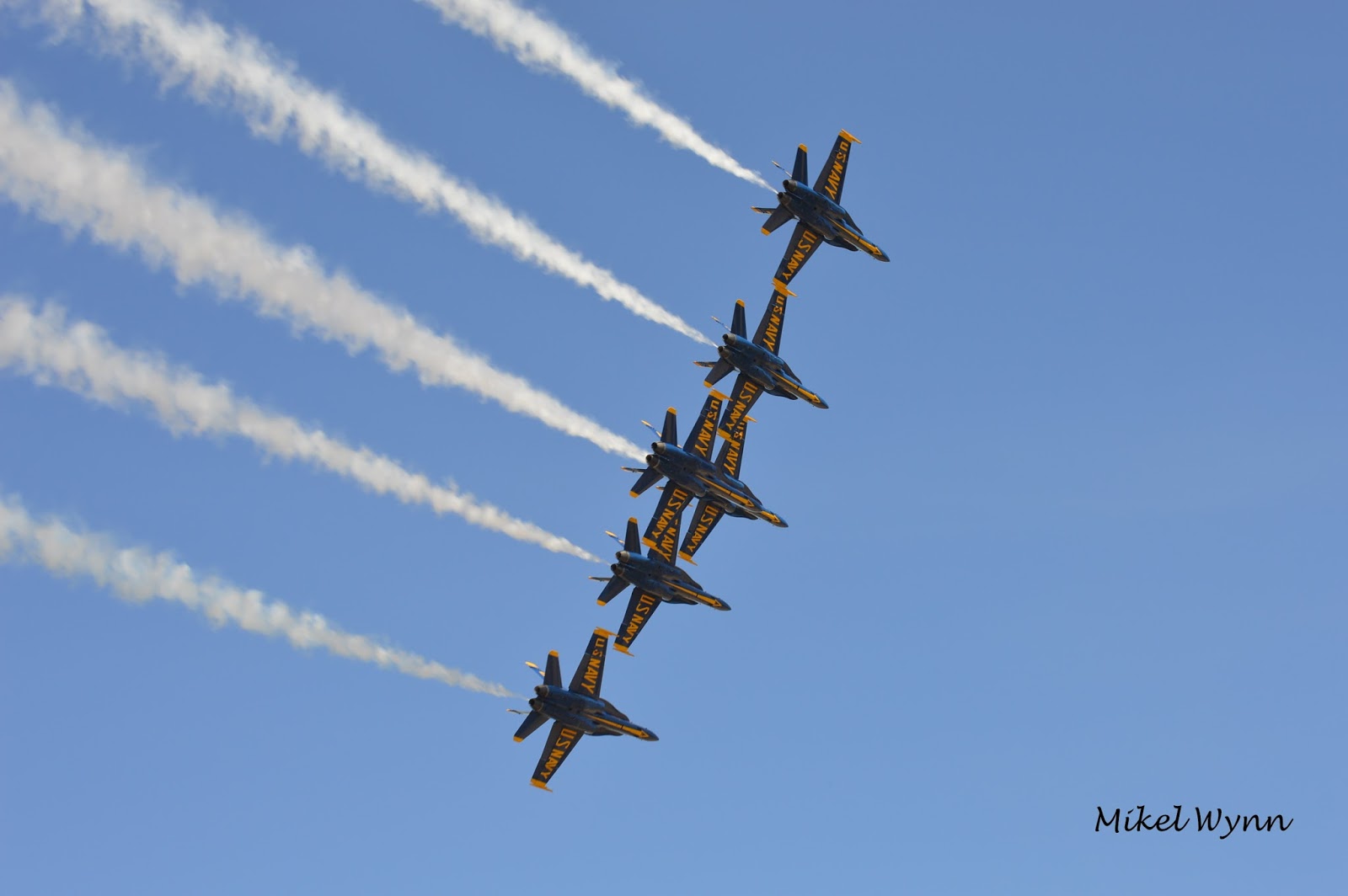
Air show season has officially started for me, starting this year with the Oregon International Air Show in Hillsboro, Oregon! This year's show headliner was the United States Navy Blue Angels; they were supposed to be the headliner two years ago for the 2013 show, a year after the Air Force Thunderbirds did the headline performance in 2012, but as many will remember, the sequestration budget cuts grounded the U.S. military, preventing them from making air show appearances. Prior to this year, the last time the Blues were at Oregon was eight years ago, back in 2007. The overall line-up of this year's Oregon International Air Show was an excellent one.
Highlights include:
- The United States Navy Blue Angels and their support aircraft from the United States Marine Corps, Fat Albert as the main headliner. The last time the Blue Angels were at the Oregon International Air Show was back in 2007. The Blues were slated to be the headliner again in 2013, but the government sequestration and the subsequent cancellation of all military performances that year changed all that.
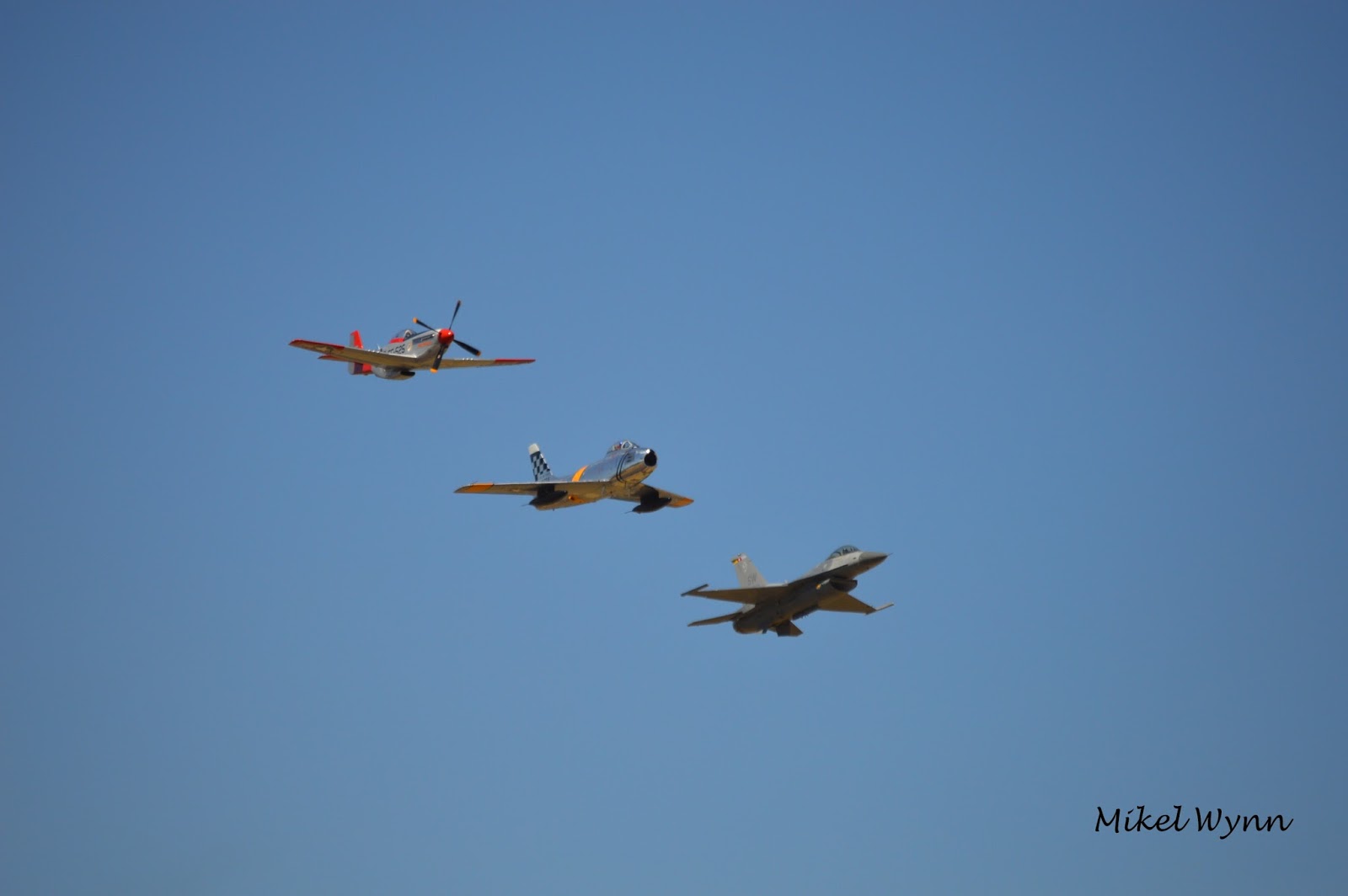
- The United States Air Force F-16 Viper Demo team with the USAF Heritage Flight; it's been a while since the Viper Demo Team made air show appearances.
- A surprise appearance of a Navy Lockheed EP-3 Orion doing a fly-by.
- The United States Air Force Academy Parachute Team "Wings of Blue" doing the opening ceremonies and demonstrating precision military skydiving.
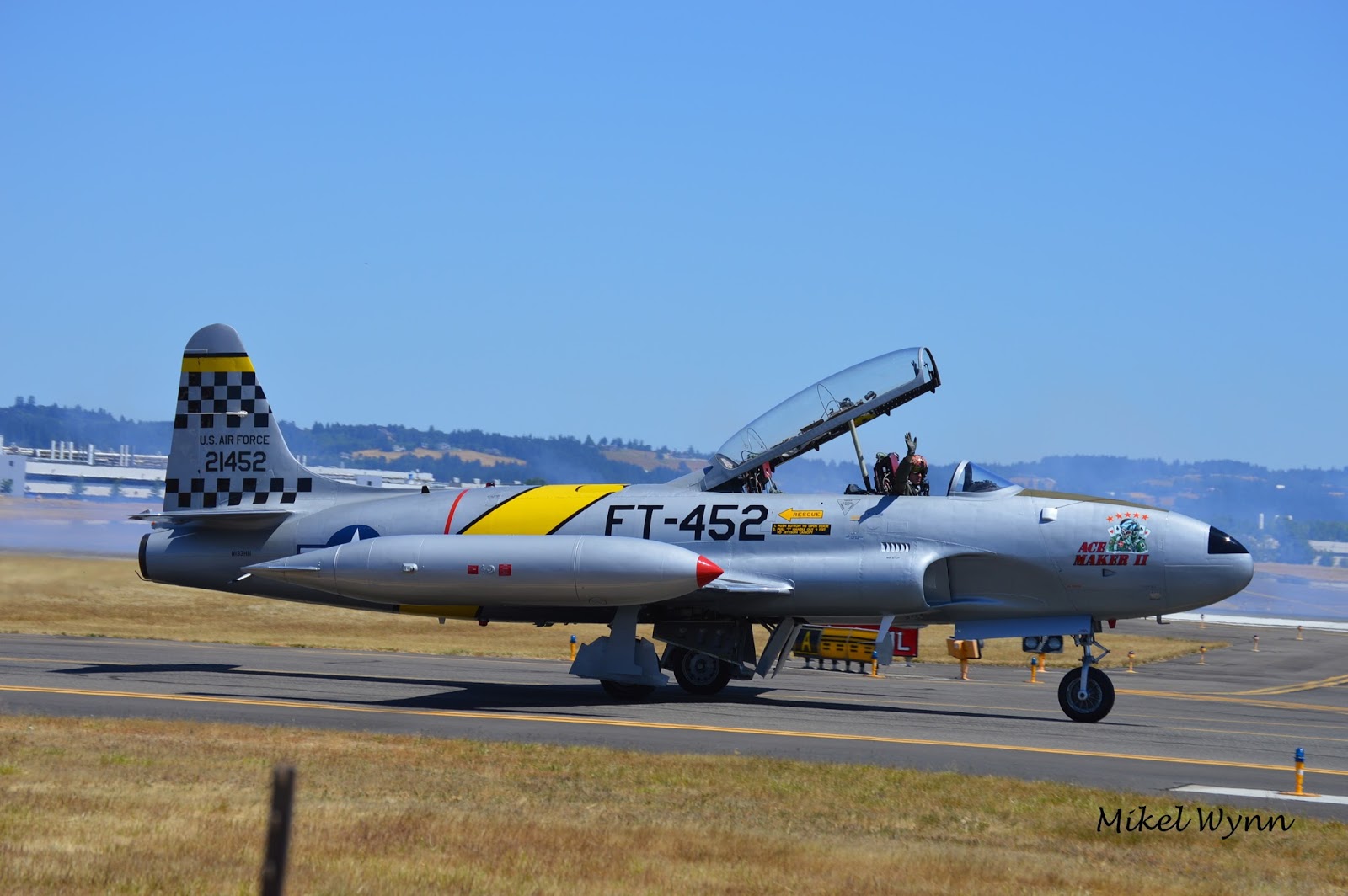
- Warbird performances by Greg "Wired" Colyer's Ace Maker Airshows in his Lockheed T-33.
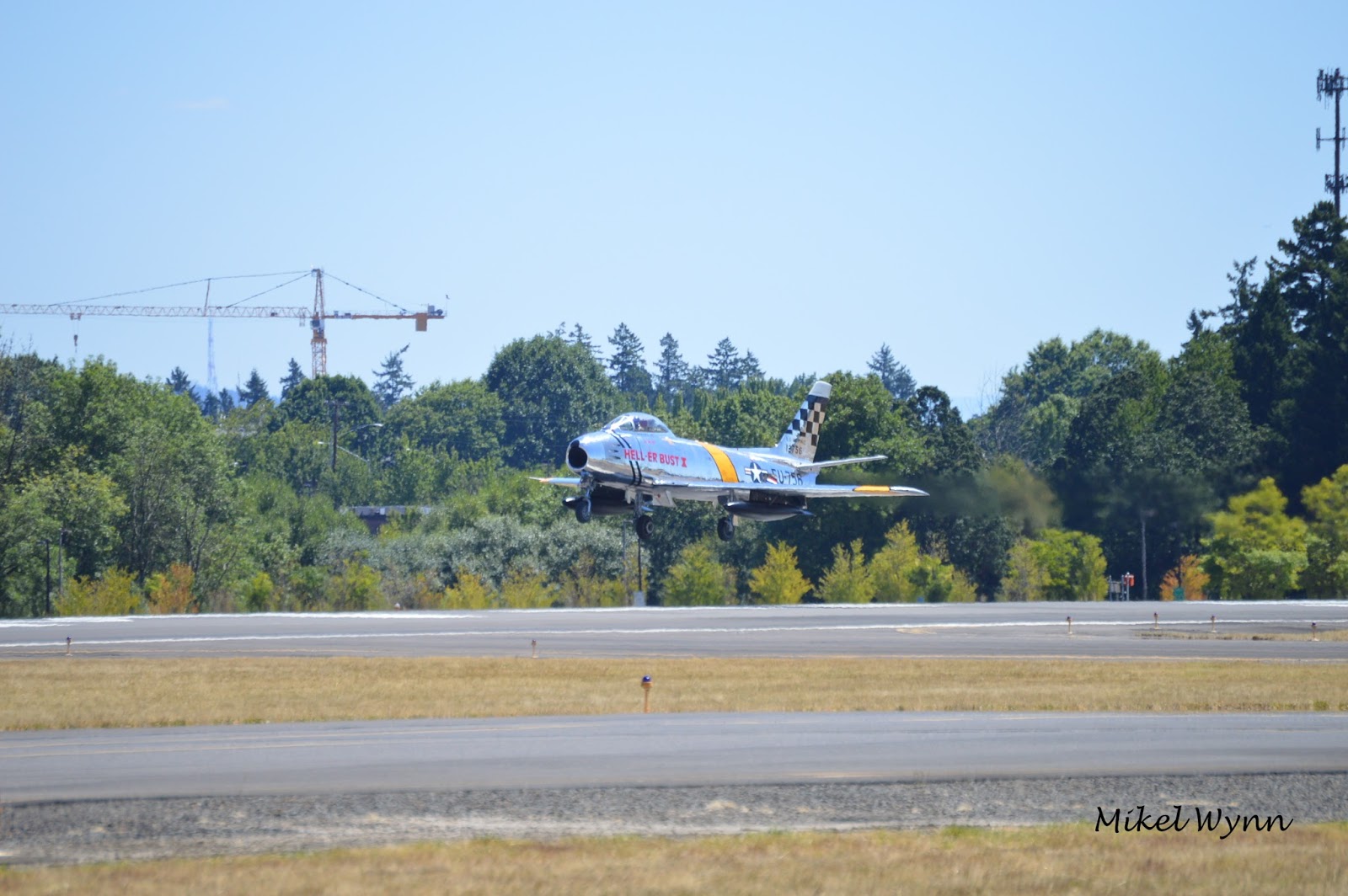
- A three-ship warbird formation flight of The Bremont Horsemen in three F-86 Sabre jets choreographed to the beautiful piece of music simply titled "Flight" written by James Horner; the team's 2015 air show season has also been dedicated to the late-James Horner, who tragically died on June 22, 2015, exactly a month before this year's Oregon International Air Show.
- The Commemorative Air Force's Red Tail Squadron brought their rare P-51C Mustang, dedicated to the Tuskegee Airmen for a performance.
- Aerobatic performances by Vicky Benzing in her red Stearman, John Klatt, Jacquie Warda, Mike Wiskus and Team Lucas Oil, Steve Stavrakakis in his rare Romanian IAR-823, Kent Pietsch, Dan Buchanan, Renny Price, and Bob Carlton.
- One unique thing that wasn't really a performance was a Robinson R22 Beta helicopter acting as a photoship; it did a fly-by to photograph the crowd line.
- And once again, Alaska Airlines, the main flight sponsor of the air show participated by bringing in one of their Dash 8 Q400s through sister-carrier Horizon to Hillsboro for a few fly-by passes.
Because of the large amount of photos I took this year, I'm going to present these photos differently. I decided to put each air show performance in its own respective album. Reasons for doing this is again, the large numbers of photos taken, giving each air show routine its own album made working on photos easier and feel faster as well. So rather than work on two or three really large photo albums, I was able to work on several smaller albums; I will start doing it this way for air show photos from now on. Plus, doing it this way makes it easier to find one or two photos I really like. The only things that haven't changed are the pre-show spotting pictures, static displays, and flight ramps. Here are the links to all my albums in order of appearance and rough time:
Phew! That's a lot of links! And now, here's a photo preview/montage of some of my favorite shots:
Pre-Show Spotting
 |
| Cessna 525B Citation CJ3 (N71F) taxiing in after arrival. |
 |
| I saw this fly overhead. It's a Hawaiian Airlines Airbus A330-243 outbound from PDX en route to Honolulu. Never thought it would end up overflying HIO... |
Static Display
It's pretty hard to get decent static display shots because of the crowd, but here are a few highlights worth mentioning:
 |
| Vought F4U-7 Corsair (NX1337A) on display. Formerly displayed at the Tillamook Air Museum, this warbird is now based at the Erickson Collection in Madras, OR. |
 |
| Classic Aircraft Aviation Museum's Aero S-106, a Czechoslovakian license-built version of the MiG-21F-13 (N6285L) on display. |
 |
| Classic Aircraft Aviation Museum's Lockheed TF-104G Starfighter (N104TF) on display. This airframe was last in military service with the Turkish Air Force before being acquired by the museum in 2001. |
 |
| Classic Aircraft Aviation Museum's Northrop F-5E Tiger II on display. The museum received this aircraft from the Republic of China (Taiwan) Air Force. |
 |
| Hawker Hunter F51 (N611JR) on display. This Hunter was first delivered to the Royal Danish Air Force in 1956. This airframe was also the very first privately owned Hunter in the U.K. and also the very same airframe that started the jet warbird movement in the U.K. |
 |
| SOCATA TBM 700 (N855KP) on display. |
 |
| United States Air Force Raytheon T-6A Texan II (08-3933) from Sheppard Air Force Base in Wichita Falls, TX of the 459th Flying Training Squadron, "Twin Dragons." |
 |
| This is what I hate about static displays: It's hard to get good shots of the aircraft with so many people! United States Air Force/Oregon Air National Guard McDonnell Douglas F-15C Eagle (79-0081) of the 173rd Fighter Wing based in Klamath Falls, OR on display. |
 |
| United States Army AAI RQ-7B Shadow UAV mounted on launcher. |
 |
| Commemorative Air Force Red Tail Squadron's rare North American P-51C Mustang (NL61429) on display at the end of air show following its remarkable performance. This aircraft and the group that's part of the CAF honors the feats of the Tuskegee Airmen. |
 |
| Renny Price's Sukhoi Su-29 (N699SU) parked on the hot ramp. Always count on local Oregonian Renny Price to be at the Oregon Air Show every year. |
Opening Acts - USAF Wings of Blue
 |
| United States Air Force Academy Parachute Team's Twin Otter rotating. It was amazing to see how quick this aircraft got in the air. |
 |
| The American Flag being brought in during opening ceremonies. |
 |
| Skydiver bringing in the flag of the United States Marine Corps. Each jumper presented a a different flag representing different branches of the U.S. armed forces. |
 |
| Skydiver bringing in the flag of the United States Navy. |
Opening Acts - EP-3 Orion Fly-By
I love surprises and this was the first time I've ever seen a Lockheed P-3 Orion in flight, which was nice considering that many P-3s are now being replaced by the Boeing P-8 Poseidon. The variant that performed the fly-by was an EP-3E Aries II, a Signals Intelligence (SIGINT) version of the venerable Maritime Patrol aircraft.
 |
| BuNo 160764 from Naval Air Station Whidbey Island, Fleet Air Reconnaissance Squadron VQ-1, the World Watchers. |
 |
| The aircraft executed a low ILS approach. |
 |
| Note all the hardware on the belly of the aircraft. |
 |
| This airframe was converted to EP-3E standards from an original P-3C Orion airframe. |
 |
| This was definitely a surprising way to kick off the air show! |
Opening Acts - John Klatt, Mike Wiskus, and Kent Pietsch
John Klatt and Mike Wiskus kicked off the aerobatics by doing a teaser demo of their full show alternating with each other. They were followed by Kent Pietsch performing a demonstration of energy management with a deadstick landing.
 |
| John Klatt with smoke on. |
 |
| Mike Wiskus with smoke on. |
 |
| Mike Wiskus in a knife edge pass. |
 |
| Kent Pietsch with two different smoke colors coming off his wingtips. |
 |
| At the top of a loop. |
 |
| Lining up for landing on a taxi way, not a runway! |
Warbirds
Warbirds are always a thrill to watch as it's a way to see history come alive. This year's Oregon Air Show had no shortage of historic warbirds.
 |
| Vicky Benzing performs in her red Stearman PT-17/R985 Kaydet (A75N1) (N63529). |
 |
| Quite an unusual sight to see a female pilot at the controls of a Stearman, considering this plane was built back in the day when only men were allowed for military service and the Stearman was the military trainer of its era. Vicky Benzing however, leads a unique and very respectable cause; encouraging more women and girls to aspire to become pilots. |
 |
| Flaring above the runway prior to touchdown. |
 |
| Taxiing past the crowd following the performance. |
 |
| Commemorative Air Force Red Tail Squadron's North American P-51C Mustang (NL61429) taking off to begin its performance. It was such a privilege to witness a C-model Mustang fly as they are considerably rarer than the D-models! |
 |
| The first of several close-up passes. Photos fail to convey the sound of that Merlin engine! |
 |
| Underside-view. From this perspective, it's harder to tell which variant of the Mustang this is. |
 |
| Photo pass. |
 |
| Perfect profile view of a C-model. |
 |
| Seeing this variant was truly a privilege. This would've been the third P-51C I've seen this year; I saw the Boise Bee earlier this year, but I missed the the Collings Foundation's P-51C due to mechanical problems at this year's Wings of Freedom Tour. |
 |
| And in honor of the Tuskegee Airmen, kudos to the CAF for this incredible tribute to them. |
 |
| Taxiing past the crowd. One of these days, I'm going to figure out how to achieve prop-blur in my photos. |
 |
| Side view |
 |
| It's just something about that red tail that makes it scream about the Tuskegee Airmen... |
Ace Maker II
Two years ago, I first saw Greg "Wired" Colyer of Ace Maker Air Shows in his Canadair T-33A-N Sliver Star 3 (CL-30) appropriately nicknamed "Ace Maker," which brought much-needed jet noise during a sequester-affected 2013 Oregon International Air Show. About a year later, he acquired another T-bird, a Canadair CT-133 Silver Star 3 (CL-30), painted up in Korean War-era USAF markings and nicknamed it "Ace Maker II," which he now uses for air shows mainly in the western United States, while the original "Ace Maker" is used for the east. And of course, he brought "Ace Maker II" this year, which many warbird aficionados including myself, really appreciated.
 |
| Smoke on, Greg brings his CT-133 (N133HH) in for a fast paced aerobatic routine. |
 |
| That distinctive underside view of a jet from the 1950s. |
 |
| A good close-up view during one of his passes. |
 |
| With clear skies, this T-33 really stands out. |
 |
| A view of the topside of the aircraft during a roll. |
 |
| A classic dirty pass! |
 |
| With a view of Greg's signature "Ace Maker" nose art, a skeleton in a fighter pilot suit and four ace cards. |
 |
| For those who didn't know, the dirty pass is called as such because the aircraft's streamline profile has been "dirtied" up due to the extension of the landing gear. |
 |
| You can tell this is Hillsboro because of all the industry in the background. |
 |
| Greg Colyer adds power to the engines just before retracting the landing gear to finish up his routine. |
 |
| Beginning of another turning pass. |
 |
| A closer view of the underside of that classic 1950s jet age look. The 1950s just show how much transition there was between the straight wing, propeller fighters of World War II and the jet age. Clarence "Kelly" Johnson sure was ahead of his time when he came up with the Lockheed P-80 Shooting Star, which would evolve into the T-33 Shooting Starr, the primary trainer jet trainer of the time. We definitely owe it to Clarence "Kelly" Johnson for designing this aircraft. |
 |
| Greg Colyer flew past some lingering smoke when I shot this photo. A little editing resulted in this, which for some reason, I kind of liked! A little "smoke filter," if you would! |
 |
| "Ace Maker II" climbing, which provided this unique angle. |
 |
| Note the distinctive wing-tip fuel tanks, a classic accessory for a classic aircraft. |
 |
| Greg Colyer bringing "Ace Maker II" in for a photo pass. |
 |
| Even though the aircraft is not centered in the frame, that was intentional because I wanted to include some of the air show smoke trail. |
 |
| Greg Colyer's "Ace Maker" is a class act! |
 |
| Class because he displays a classic warbird! |
 |
| Bringing in "Ace Maker II" for landing. |
 |
| Flaring... |
 |
| Moments from touchdown... |
 |
| And touchdown. |
 |
| Taxiing past the crowd. |
 |
| Close-up view the nose art and aircraft profile. Beautiful paint job for a beautiful aircraft! |
 |
| Thanks Greg, for an awesome performance! |
Steve Stavrakakis & the IAR-823
Here's a unique one from a more the general aviation category: Steve Stavrakakis is a professional air show announcer who works at some of the big prestigious air shows around the United States, notable ones including the Reno Air Races, the Truckee-Tahoe Air Fair, and the Apple Valley Air Show. When he's not announcing, he's performing in his aircraft, a rare IAR-823. Built by Romanian aerospace manufacturer Industria Aeronautică Română (Industry of Aeronautics, now IAR S.A. Brasov), the IAR-823 is a civil and military trainer aircraft built in Romania from 1974 until 1983. Romanian Air Force operations of the aircraft became a problem in the early 90s because the fuel required for the type was no longer produced in country and had to be imported from Greece, at a time when budget problems plagued the Air Force. Although there is no official date for the IAR-823's retirement from Air Force service, it seems that it was grounded in the 1995-96 time frame. All the surviving airframes were put in storage at Brasov and eventually put up for sale as surplus. Out of 80 airframes built, several remained in Romania for museum displays as well as for flying clubs, where they were restored to flying condition. Over half the airframes built were sold to private owners in the United States, including Steve Stavrakakis'; his IAR-823 is the only one known to be flying professionally in the world. His air show routine is called "Tribute to the American Vet." Painted in the USAF Vietnam era jungle paint scheme of the 8th SOS, 14th SOW based at Bien Hoa (ben-wa) Air Base,Vietnam, Steve Stavrakakis' IAR-823 utilizes smoke and pyrotechnics.
 |
| Stavrakakis' IAR-823 (N823WT) on take-off roll. |
 |
| Smoke on |
 |
| Smoke from the wing tips. |
 |
| Hard to believe an aircraft of this size used to be a military trainer. |
 |
| Stavrakakis putting his IAR through its paces. |
 |
| Unique topside view of the aircraft. |
 |
| One final pass before landing. |
 |
| Landing |
 |
| Taxiing past the crowd with Stavrakakis giving a thumbs up. |
The Bremont Horsemen Aerobatic Team
I saw them for the first time at last year's Oregon International Air Show and now they're back again this year! Hands down, the Horsemen Aerobatic Team IS one of my top favorite air show routines because of the perfect combination of the type of aircraft and the music used. Led by Steve Hinton with Ed Shipley on the left wing and Dan Friedkin on the right, the Bremont Horsemen performed in three Korean War-era F-86 Sabre jets choreographed to the
late-James Horner's beautiful piece of music written for the team, the perfect marriage between the joys of flying and the joy of good music, "Flight." I must confess, this performance was gut-wrenching and emotional for me as it had me in tears. Academy Award winning composer James Horner, a pilot himself, died in a plane crash about one month ago now and he left a significant mark on all who heard his beautiful music that he wrote. Horner composed musical scores for some of the greatest films we've seen in the past two decades, including 'Glory,' 'Titanic,' 'Apollo 13,' 'Avatar,' and many more. In this day and age where the Hollywood film industry thrives on sleaze, scandals, violence and vulgarity, it leaves very few people to actually have genuine respect for. James Horner was one of few in the Hollywood film industry I had a great deal of respect for. And now with him gone, and as I heard his 12-minute long composition with the Horsemen performing, I couldn't help but shed a few tears... The Bremont Horsemen dedicated the remainder of their 2015 air show season to the late-James Horner as well.
 |
| Flight lead Steve Hinton (a man who needs no introduction!) taking off in a North American F-86F Sabre (NX860AG). |
 |
| Right wingman Dan Friedkin taking off in a North American F-86F Sabre (NX186AM) nicknamed "Jolley Roger." |
 |
| Left wingman Ed Shipley taking off in "Hell-er Bust X," a Canadair CL-13B Sabre 6 (NX1F), a Canadian license-build version of the F-86F. |
 |
| The first of many passes. |
 |
| The Sabre, North American Aviation's crown jewel of the jet age. |
 |
| To fly like this, you need some of the greatest warbirds pilot in the world. |
 |
| I'm grateful I got to see the Horsemen again. |
 |
| Three-ship photo pass |
 |
| I completely blew the chance to get this shot clearly last year, but I redeemed myself this year. This is my favorite shot of the three Sabres! |
 |
| Show center and overhead. |
 |
| The Sabre is just beautiful from all angles! |
 |
| Beginning the formation split. Note the wingmen having now ignited their smoke system. |
 |
| This one was amazing! The crowd went nuts when they saw the three-ship do a bomburst-style formation split! |
 |
| Dan Friedkin doing a solo pass in "Jolley Roger." |
 |
| Steve Hinton, one of the original "Chino Kids" and president of the Planes of Fame Museum in Chino, CA doing a victory roll. |
 |
| Ed Shipley performing a victory roll in "Hell-er Bust X." Ed Shipley, a founding member of the Bremont Horsemen, was the one who asked James Horner to compose the piece of music the team choreographs to. |
 |
| Dan Friedkin having just landed. Note the speed brakes deployed. |
 |
| Steve Hinton bringing in his F-86F for landing. |
 |
| Note Steve Hinton's landing technique. |
 |
| Demonstration of expert airmanship. |
 |
| Known as aerodynamic braking, by keeping the nose gear up as long as possible, a pilot can slow down an aircraft upon landing this way by using the wings and the fuselage to assist the wheels in slowing down, thus saving the brakes on the landing gear from continuous wear-and-tear. This method is also used for short runway ops, or when runways are wet or slippery. |
 |
| Ed Shipley bringing "Hell-er Bust X" in for landing. |
 |
| I live for shots like this! Note the right main gear contacting the runway while the left main gear is still in the air. |
 |
| Ed Shipley also did a little aerodynamic braking. |
 |
| Time for the Sabre jet's close-up! Steve Hinton in NX860AG. |
 |
| Steve Hinton giving the crowd a wave. Thanks Mr. Hinton, as always! |
 |
| Dan Friedkin in NX186AM, "Jolley Roger." |
 |
| Ed Shipley in NX1F, "Hell-er Bust X." |
Aerobatics
 |
| Jacquie Warda and her Extra EA-300 (N345JB). |
 |
| Kent Pietsch having landed on top of the moving pick-up truck platform. |
 |
| Kent Pietsch teamed up with Dan Buchanan to provide a rather entertaining "air space incursion" comedy act. Over the radio, Buchanan called Pietsch's Jelly Belly plane "Yellow Belly." We got some good laughs out of this one! Here's Kent Pietsch "stealing" some of Buchanan's hang glider streamers. |
 |
| Kent Pietsch in his "Yellow Belly..." uh, I mean Jelly belly Interstate S-1A-65F Cadet (NC37428) having just landed. Note the streamers he "stole" from Dan Buchanan! |
 |
| After his little "dogfight" with Kent Pietsch, Dan Buchanan did his own unique routine. Here he is releasing from his tow cable. |
 |
| Dan Buchanan is a paraplegic. He lost his ability to walk after suffering a spinal injury landing a hang glider in bad weather. After some time, he got back into flying and now performs at air shows. |
 |
| Note all the little puffs of white smoke from the pyrotechnics. |
 |
| Dan Buchanan coming in to land. |
 |
| The hang glider model is a Northwing Pulse 10 Meter (N62073). It's quite unusual for a hang glider to be given an N-number and labeled 'Experimental' but because of the commercial entertaining Buchanan, does, it's required. In fact, Buchanan's hang glider is the only one in the U.S. register. |
 |
| Renny Price in his Sukhoi Su-29 (N699SU). |
 |
| What's an air show without some fire? Renny Price flying by a wall of fire set off during a knife-edge pass. |
Horizon Air Fly-By
Once again, the Alaska Airlines Group was the main flight sponsor for the 2015 Oregon International Air Show. They sent in one of sister-carrier Horizon Air's Q400s to do a couple fly-bys. University of Oregon Duck fans, this one's for you!
 |
| Horizon Air Bombardier DHC-8-401 Dash 8 Q400 (N407QX), the Oregon Ducks special. |
 |
| Landing gear down, giving us the wing wave. You NEVER see a commercial airliner doing this revenue service! |
 |
| Also, not many places in the U.S. where a commercial airliner makes an air show appearance! |
 |
| Here's another wing wave. |
 |
| High speed photo pass before returning to PDX to be put back into revenue service. |
 |
| Even though I see the tops of Horizon Q400s whenever I go to PDX to do some spotting, I never see this angle while one is in flight. |
Team Lucas Oil
 |
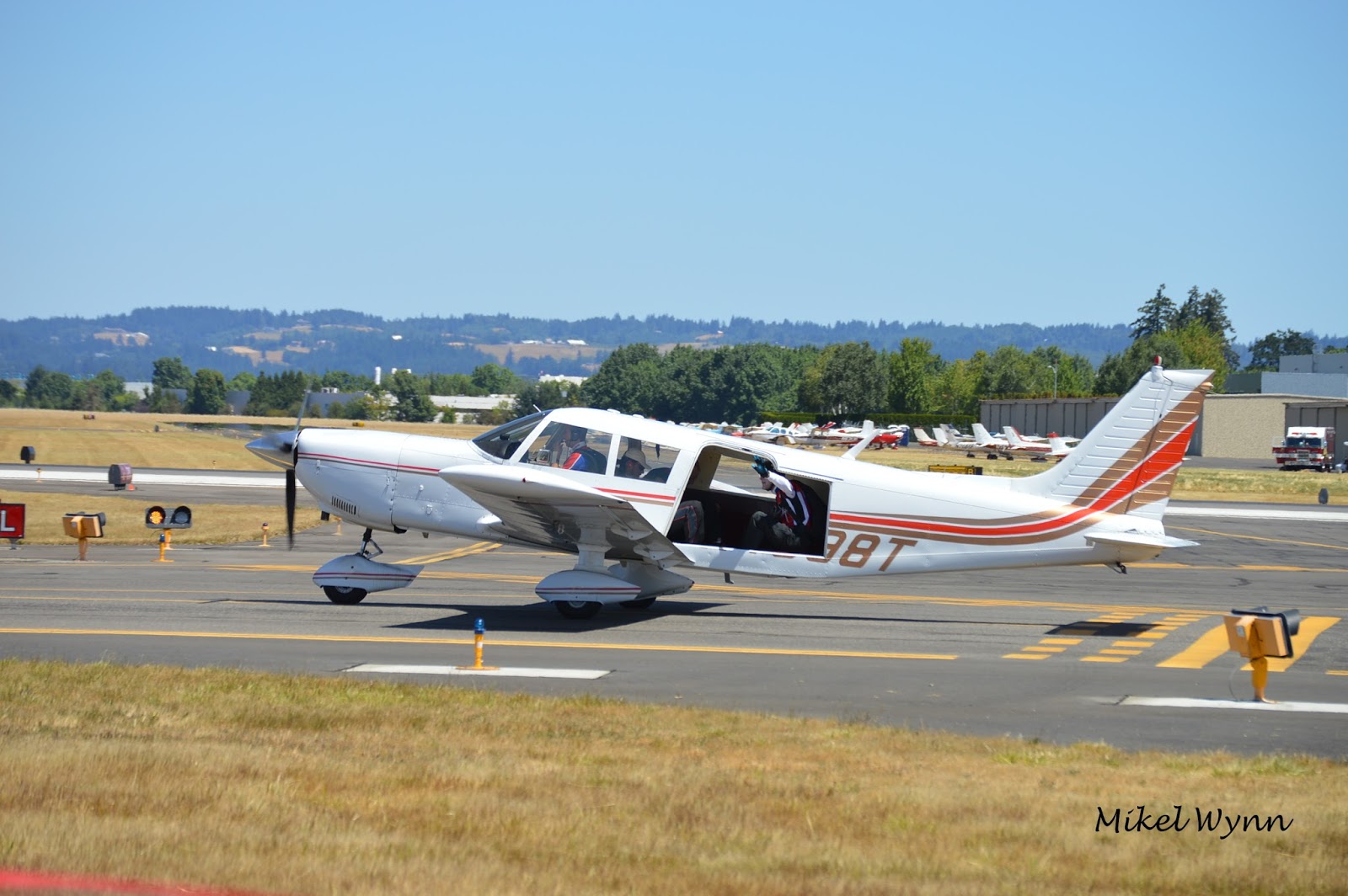
| The sky diving team's jump aircraft, a Piper PA-32-260 Cherokee Six E (N4598T). |
 |
| Jump aircraft taking off. |
 |
| Mike Wiskus and sky diver. |
 |
| Mike Wiskus in a knife edge pass in his Pitts S-1-11B/260 Super Stinker (N5111B). |
 |
| Pulling out of the knife edge. |
 |
| Jump aircraft returning to the ramp. |
Bob Carlton & the Super Salto Jet Sailplane
Bob Carlton was back again this year bringing jet noise from the most unusual aircraft, a jet-powered glider.
 |
| Bob Carlton's Start & Flug H-101 Salto (N101AZ) getting towed into position. |
 |
| This is definitely one of the most graceful performances of the day. |
 |
| Bob Carlton bringing his jet glider around. |
 |
| At the top of the loop. |
 |
| Normally if you see a glider this close to the ground, it's landing. Not with Bob Carlton! |
F-16 Viper Demo & United States Air Force Heritage Flight
 |
| The Heritage Flight Museum's North American P-51D Mustang (N151AF) "Val-Halla" taking off. At the controls is Greg Anders, son of Apollo 8 Astronaut William "Bill" Anders. |
 |
| We got a single fly-by photo pass, which was a nice bonus. |
 |
| This paint scheme is a post-war Arctic scheme of the 57th Fighter-Interceptor Squadron, which is now inactive. The 57th FIS, also known as also known as "The Black Knights of Keflavik," provided air defense to Iceland, which didn't have its own air force. |
 |
| Really cool to see a C and D model of the Mustang at one air show. I only wish they flew the two together... |
 |
| "Viper" rocketing into Hillsboro! |
 |
| In afterburner! |
 |
| I love the smell of jet fuel! |
 |
| At the controls of this year's Viper Demo aircraft is Captain Craig Baker, callsign, "Rocket." |
 |
| The term 'agile' comes to mind... |
 |
| F-16CM Fighting Falcon (91-0376) from the 20th Fighter Wing, based at Shaw Air Force Base, SC. This is my best shot of the day with the Viper! |
 |
| More afterburner! |
 |
| Low-speed pass |
 |
| Photo pass |
 |
| On loan from the Bremont Horsemen, Tommy "Limiter" Williams takes off in the Sabre. |
 |
| P-51 and F-86 joined up, awaiting the F-16 to join the formation. |
 |
| F-16 joining the warbirds. |
 |
| The first pass |
 |
| Three generations of American air power in one photo. |
 |
| Second pass. |
 |
| Third and final pass |
 |
| Formation break! |
 |
| Captain Craig Baker putting the F-16 in its parade pass. |
 |
| Tommy "Limiter" Williams in the Canadair CL-13B Sabre 6 "Hell-er Bust X." |
 |
| Greg Anders in the P-51D Mustang "Val-Halla" in a parade pass followed by a victory roll. |
 |
| One more high-speed pass in the Sabre with Tom Williams at the controls. |
 |
| Greg Anders bringing "Val-Halla" in for landing. |
 |
| Tommy Williams landing the Sabre. |
 |
| Tommy "Limiter" Williams taxis the Sabre past the crowd. |
A Few More Aerobatics...
 |
| John Klatt performing in his MX Aircraft MXS (N530JK). |
 |
| Kent Pietsch showing off. |
 |
| Kent Pietsch, minus the right aileron! |
United States Marine Corps C-130 "Fat Albert"
Before long, it was time for the headliner performances by the Blue Angels, starting with the United States Marine Corps' C-130T Hercules known as "Fat Albert."
 |
| United States Marine Corps Lockheed C-130T Hercules (164763) Blue Angels support aircraft back-taxiing on Runway 31L. |
 |
| Banking left turn |
 |
| Demonstrating the versatility of the Hercules. |
 |
| These guys definitely push the Hercules' flight envelope. |
 |
| Pilot in command is the first female Blue Angel pilot Captain Katie Higgins. |
 |
| Climbing left bank |
 |
| Diving in for a landing. |
 |
| Moments from touching down. |
 |
| Taxiing past the crowd. |
United States Navy Blue Angels
And finally, the main headliner, the Blue Angels; first time seeing them in six years.
 |
| Blue Angel #5, a McDonnell Douglas F/A-18C Hornet (163451) taxiing past the crowd. At the controls is Lieutenant commander Mark Tedrow. |
 |
| Blue Angel #6, another McDonnell Douglas F/A-18C Hornet (163442) with Lieutenant Ryan Chaimberlain at the controls taxiing alongside Blue Angel #5 past the crowd. |
 |
| The Diamond formation (#s 1-4) taking off. |
 |
| Blue Angels #s 5 & 6 on take-off roll. |
 |
| The main Diamond in tight formation. |
 |
| Underside view of the Diamond. |
 |
| The solo jets with landing gear and tail-hooks extended. |
 |
| The Diamond passing by with landing gear and tail-hooks extended. |
 |
| Diamond formation's Echelon Parade Pass. |
 |
| The two solos in a slow-speed pass |
 |
| All six jets forming the Delta formation. |
 |
| The Delta formation in a bomburst maneuver. |
 |
| Blue Angel #1, under the command of Captain Tom Frosch in a F/A-18C Hornet (163754) leads the Delta formation. |
 |
| The Delta Formation coming around for another pass |
 |
| The Delta breaking formation |
 |
| One final pass from the Delta formation prior to breaking up in preparation for landing. |
 |
| Blue Angel #4, a McDonnell Douglas F/A-18B Hornet (162885) two seat variant landing. Aircraft is under the command of Lieutenant commander Nate Barton, the slot position. The only problem with this photo? An empty backseat in the jet! |
And that's a wrap for another great year at the Oregon International Air Show!